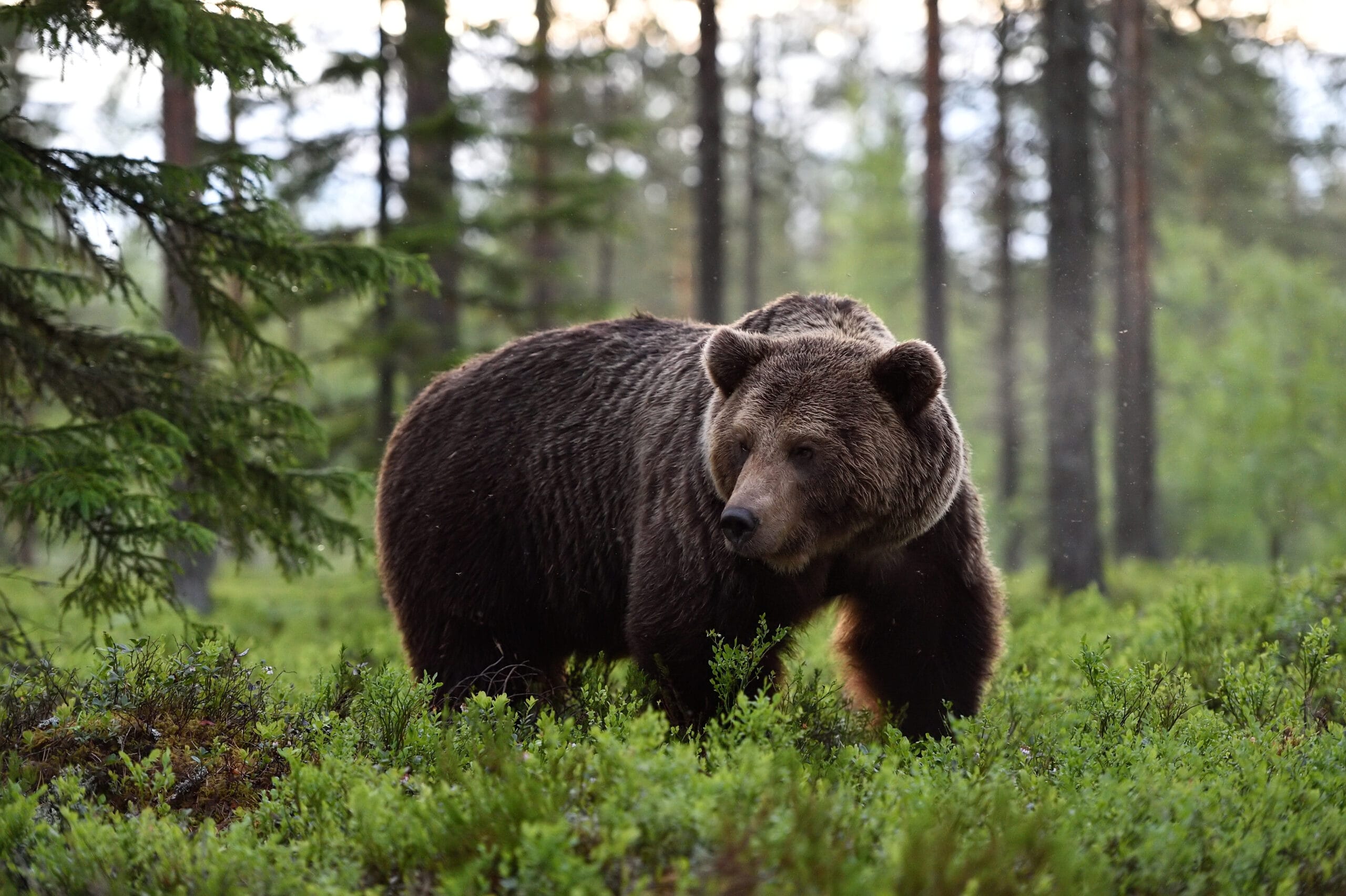
Mr. Joe Pendry was a familiar name in my hometown of Cranbrook, BC. I imagine we wandered through some of the same forests and valleys, hunting deer and elk in places where grizzlies are ever-present. Our experiences in those wild spaces connected us in a way, sharing both the excitement and the risks that come with living and hunting in grizzly country. On October 2nd, 2025, Joe experienced what every hunter fears — being attacked by a grizzly bear. It’s heartbreaking to know that Joe lost his life a few weeks after the attack. His passing marks a sobering moment in the story of grizzly bear encounters in Canada, reminding us all just how quickly things are changing on the landscape.
Over the past thirty-five years, interactions between humans and bears in Canada have shifted in notable ways. By examining data on grizzly and black bear attacks and fatalities from 1990 to 2025, we can better understand these changes and their implications for safety of rural people, hunters and backcountry users. It is important to recognize that while earlier statistics cover full decades, the 2020–2025 segment represents only five years of the current decade which ends in 2029.
Limitations in Bear Attack Reporting
Attack statistics in Canada are quite disorganised due to the absence of a centralized database. However, this is not unlike other countries that have a mish mash of government records and media news stories. In some regions, including India and Africa, not all attacks are documented by the governments or news media, so the true human impact of attacks is hidden. In Canada, we rely mainly on news coverage and limited scientific studies.
Defining a bear attack is also complex: typically, only incidents where a bear physically contacts a person resulting in an injury and or fatality are counted as an attack, meaning near-misses, including aggressive confrontations involving imminent danger to life and limb or incidents where an aggressive bear was deterred using a firearm or bear spray are not included as an official attack.
Bear attack records generally classify attacks involving several people—either injured or deceased—as one attack. This reporting practice can understate the actual impact on people, as it does not reflect the full extent of emotional consequences or the complexities arising from human-bear population encounters within a region. By treating multi-victim events as a single occurrence, the statistics may fail to capture the broader effects that such attacks have on communities, social attitudes towards bears and the imbalance between people and bears in affected areas.
Bear Attack Trends: 1990–2025
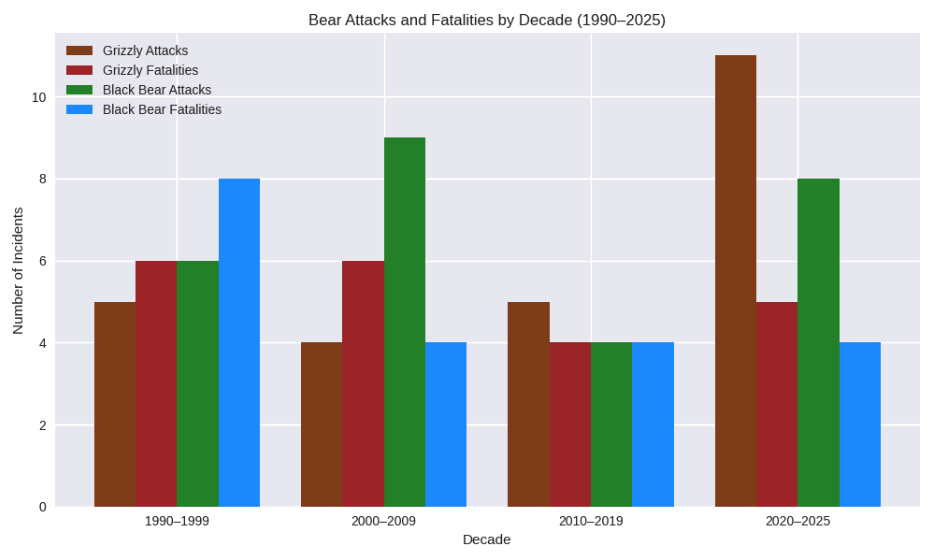
Recent years have shown dramatic changes in bear encounter patterns:
- Grizzly Bears: The number of grizzly bear attacks surged to 11 in the 2020–2025 period—more than double that of any previous full decade. Since this figure covers only half a decade, the annual rate is significantly higher than in earlier periods. If this trend continues, the next decade could see a record number of grizzly fatalities.
- Black Bears: Black bear attacks peaked at 9 in the 2000–2009 decade. In the first five years of the 2020s, there have already been 8 attacks and 4 fatalities, suggesting that the total for the decade could surpass past periods if the current pace continues.
The data for 1990–2023 in the above chart is sourced from Alexandra C. Poirier’s 2024 undergraduate thesis (Lakehead University), which documents 39 fatal bear incidents—17 involving grizzlies and 22 involving black bears—based on 47 news reports from Canadian and U.S. media sources. Poirier’s research aimed to uncover trends in attack frequency, determine whether incidents were predatory or defensive, and examine underlying factors such as habitat disruption, urban expansion, and human behaviour.
Poirier found that overall fatalities have remained relatively stable across previous decades. Notably, black bear fatalities decreased during 2010–2019, but increased slightly from 2020 to 2023, a change potentially linked to more outdoor activity during the COVID-19 pandemic. However, many reports lacked detail, making it difficult to consistently classify attacks as either predatory or defensive.
Alexandra’s thesis concludes that most fatal grizzly bear attacks in Canada occur in British Columbia and Alberta. In contrast, fatal black bear attacks are more widely distributed across multiple provinces, reflecting the species’ broader range across Canada. However, Poirier notes that black bear attacks are more likely to occur in suburban or semi-rural areas where bears enter human spaces in search of food—often due to habitat fragmentation or attractants like garbage and livestock feed.
Understanding Bear Behaviour and Human Impact
Grizzly bears, found mostly in Western and Northern Canada, are solitary and sensitive to human activity. They are often defensive—especially mothers with cubs—but can be predatory in certain circumstances. Black bears, more widespread across the country, are highly adaptable and frequently venture into suburban areas when natural food is scarce. While defensive behaviour is common among black bear mothers, predatory behaviour is characterized by silent stalking.
Human-bear encounters are shaped by factors such as food conditioning, habitat fragmentation, and recreational use. Bears accustomed to human food sources including garbage, pet food, and livestock may become less wary and more likely to approach people. Urban development into bear habitats has fragmented ecosystems and increased the likelihood of encounters. Recreational use of trails also affects bear behaviour, with grizzlies reacting more strongly in less-frequented areas and black bears adjusting activity patterns in response to human presence.
The thesis underscores the need for public education, management of attractants, and thoughtful urban planning to reduce bear-human conflicts. Consistent and detailed incident reporting is also essential for improving future analysis and management strategies. Ultimately, while fatal bear attacks remain rare, understanding their ecological and social context is key to promoting safer coexistence.
Long-Term Trends and Management Strategies
A recent technical report by Stringham, Rogers, and Bryant examined bear attacks from 1900 to 2019. Fatalities rose from five in the early 1900s to 28 in the 2010s, following a curve—rapid growth, then stabilization. This trend suggests that fatalities have risen, but the rate of increase has slowed—likely due to improved safety measures
The study challenges the idea that bears have become more aggressive, showing that increases in fatalities are linked more to human population growth and expanding human activity in bear habitats than to changes in bear behaviour or numbers. In fact, grizzly populations have remained stable in most regions, and black bear numbers have increased mainly in areas with few fatalities.
Safety precautions introduced since the 1970s—such as food and garbage containment, public education, and bear deterrents—have helped flatten or reduce fatality rates, even as both bear and human populations continue to grow. For example, both fatal and non-fatal attacks have declined in Yellowstone despite rising visitation and bear numbers.
The report also explores bear motivations in fatal encounters, noting that black bears are more likely to kill in predatory contexts while grizzlies tend to be defensive. However, fatality rates for both species are positively correlated, suggesting that factors such as bear size, human behaviour, and access to medical care play a major role in outcomes.
Interestingly, the report notes that habituation and food conditioning may sometimes lower risk rather than increase it. The authors call for ongoing research, continued investment in safety measures, and stronger partnerships between agencies and wildlife stewards to reduce both human injuries and bear mortality.
Can Hunting Play a Role in Reducing Attacks?
Grizzly bear hunting was banned in British Columbia in 2017 and Alberta in 2006. Some suggest that this has led to more grizzly attacks. Black bears are still hunted across Canada, yet they account for more attacks and fatalities than grizzlies in the earlier decades and they are on the rise in the 2020 decade, challenging the idea that hunting alone influences bear aggression.
A 2024 study by Birdsong and colleagues, published in Conservation Biology, sheds new light on how social identity shapes public attitudes toward grizzly bears and wildlife management. Drawing on survey data from Montana residents, the researchers found that whether someone identifies as a hunter or non-hunter plays a more significant role in shaping their views on grizzlies than direct personal experience with the animals.
Hunters, the study found, were more likely to express negative attitudes toward grizzly bears. These views were often rooted in concerns about personal safety, competition for game, and a cultural narrative that frames grizzlies as threats. Within hunting communities, stories of bear encounters—especially those involving danger or conflict—tend to circulate widely, reinforcing a shared sense of risk and opposition to bear preservation measures.
In contrast, non-hunters generally held more positive or neutral views of grizzlies. For many, the bears symbolized wilderness, ecological integrity, and the success of conservation efforts. Their perceptions were shaped less by direct experience and more by broader environmental values and narratives that emphasize coexistence and species protection.
The study emphasizes that effective wildlife management must go beyond facts and risk assessments. Instead, it calls for communication strategies that acknowledge and engage with the cultural identities and values of different stakeholder groups. By understanding how social identity influences perception, agencies and advocates can better navigate the polarized landscape of large carnivore conservation and foster more constructive dialogue across diverse communities.
Some proponents argue that hunting could instill a “fear of humans” in bears, potentially reducing boldness. However, this idea lacks robust empirical support. A 2019 article by Steven Rinella’s MeatEater explored this hypothesis but acknowledged that it remains speculative and untested in peer-reviewed literature.
Impacts of Grizzly Bear Hunting Bans Management
Banning grizzly bear hunting has resulted in a significant reduction, and in some cases complete elimination, of government-led research on grizzly populations in some regions. For instance, British Columbia previously maintained a world-class research program focused on monitoring grizzly bear numbers and tracking both hunting and non-hunting related mortality. The primary aim of this program was to ensure that regulated hunting was not contributing to a decline in grizzly bear populations.
With the sharp increase in attacks in the first half of the 2020-2029 decade the absence of grizzly population data poses a significant risk to humans because it prevents wildlife managers from accurately assessing bear numbers, identifying high-risk conflict areas, and implementing targeted safety measures. Without reliable population estimates, it is difficult to allocate resources effectively, anticipate bear-human encounters, or track the impact of policy changes such as hunting bans. This lack of information could lead to delayed responses, insufficient public education, and missed opportunities to prevent future incidents.
The Future of Grizzly Bear Management
Analysis of long-term data shows that bear encounters and attacks vary over the years, but the number of fatalities has largely stayed consistent. Recently, there has been an observed increase in grizzly attacks, and if this trend continues, the next decade could potentially see a higher number of fatalities than previous decades. As the landscape evolves, both human and bear populations are increasing and increasingly occupying the same areas. This shift presents new challenges and underscores the importance of adapting management strategies to current realities.
Grizzly bear hunting in Western Canada follows the principle that human-caused bear deaths, including hunting, should not lead to population decline. Even after British Columbia and Alberta banned hunting, this principle remained central. Hunting in these provinces was not used to “control” or reduce bear numbers due to its low harvest rate and emphasis on harvesting mature males. Any reconsideration of grizzly hunting in these provinces requires re-evaluating this approach, especially when setting objectives for local-level human-bear interactions.
The future of grizzly management in Canada must include setting clear objectives including establishing how many human–grizzly encounters are acceptable and allowing for the sustainable use of bears. Adapting to these shifting realities will be key to ensuring that people and bears can continue to coexist safely as our landscapes continue to change.
Bear mortality and conflict-related deaths caused by humans occur. Permitting the sustainable use of bear meat, hide, and other parts can promote the efficient utilization of animals that are killed, rather than disposing of them as waste.
In Western Canada, urban philanthropists and their foundations influence grizzly bear management discussions, often sidelining rural perspectives. Wild Origins Canada’s Project Grizzly Balance aims to reconnect science, community values, and management to restore the balance between rural people and grizzly bears.
__________________________
Appendix. Combined Bear Attack and Fatality Data (1990–2025)
| Decade | Grizzly Attacks | Grizzly Fatalities | Black Bear Attacks | Black Bear Fatalities |
| 1990–1999 | 5 | 6 | 6 | 8 |
| 2000–2009 | 4 | 4 | 9 | 9 |
| 2010–2019 | 5 | 6 | 4 | 4 |
| 2020–2025* | 11 | 5 | 8 | 4 |
*Note: The 2020–2025 figures reflect only five years, not a full decade.
Data Sources: Poirier, A. C. (2024). A comparison of reports of fatal grizzly and black bear attacks in Canada (1990-2023) and media news reports for attacks in 2024 & 2025