• Skip to main content
Menu
Donate
  • Projects

    +

    • Conservation Projects
    • Origins Foundation Stories
    • The Helix Program
    • Panyame Cheetah Project
  • Documentaries

    +

    • Featured Documentary
    • All Documentaries
  • Stay Informed

    +

    • News Alerts
    • Podcasts
    • Conservation Resources
    • Proof: Conservation in Action
    • Truth: Origins Foundation Perspectives
    • Field Stories
    • View All Content
  • Support The Origins Foundation

    +

    • Individual Supporters
    • Corporate Conservation Club
    • Projects Needing Funding
  • What Is The Origins Foundation?

    +

    • Our People
  • Wild Origins

  • Upcoming Events

    +

    • ConservatiONE 2026
    • All Upcoming Events
  • Get In Touch

  • Shop Merch

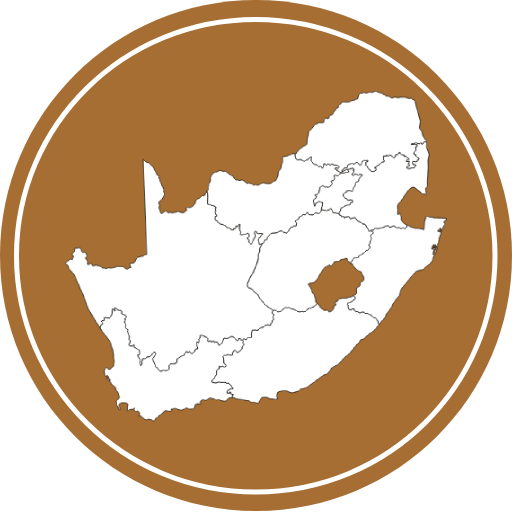
South Africa Elephant Information
Conservation Resources
Share

South Africa Elephant Information

Your support helps us fund more projects.

Donate Today

By the Numbers

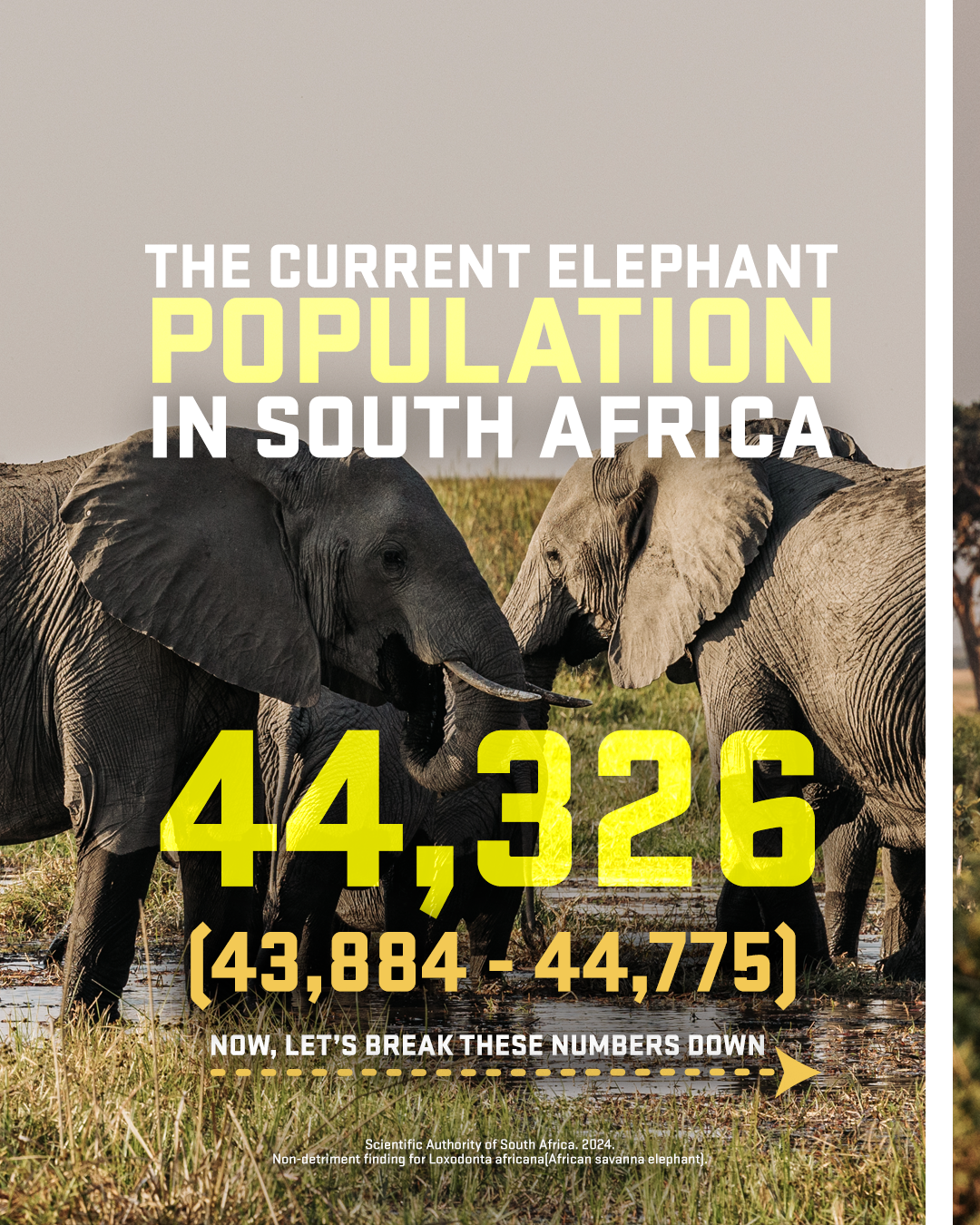
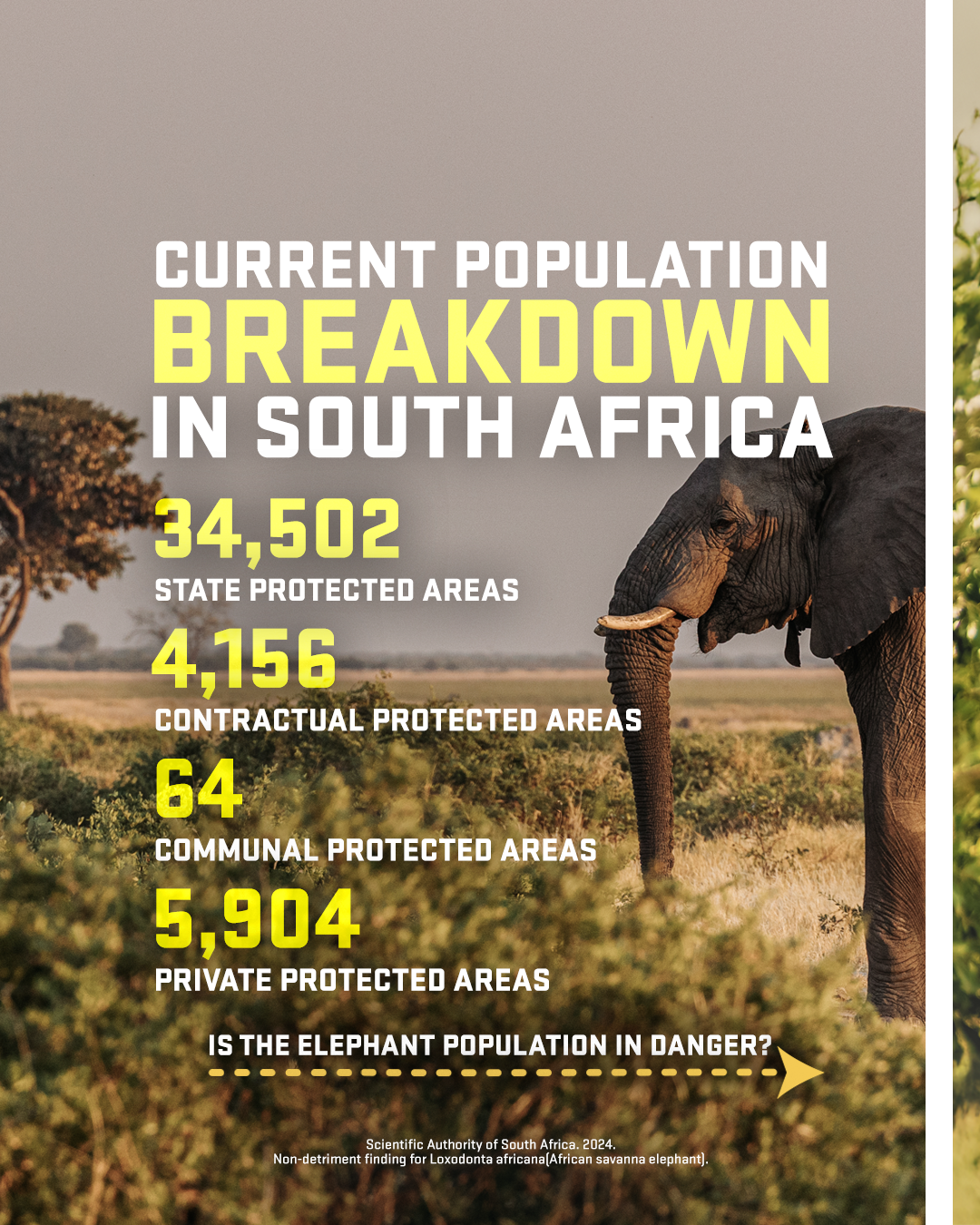
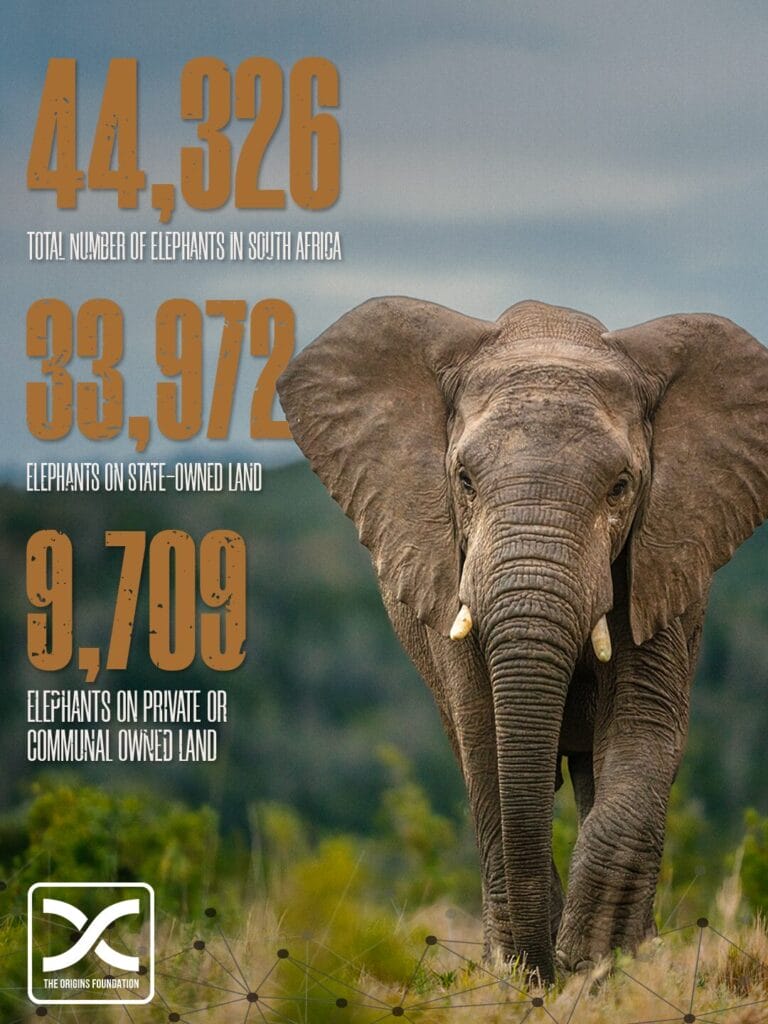
0 Elephants

Total Number of Elephants in South Africa

0 Elephants

On state-owned land

0 Elephants

On private or communal owned land

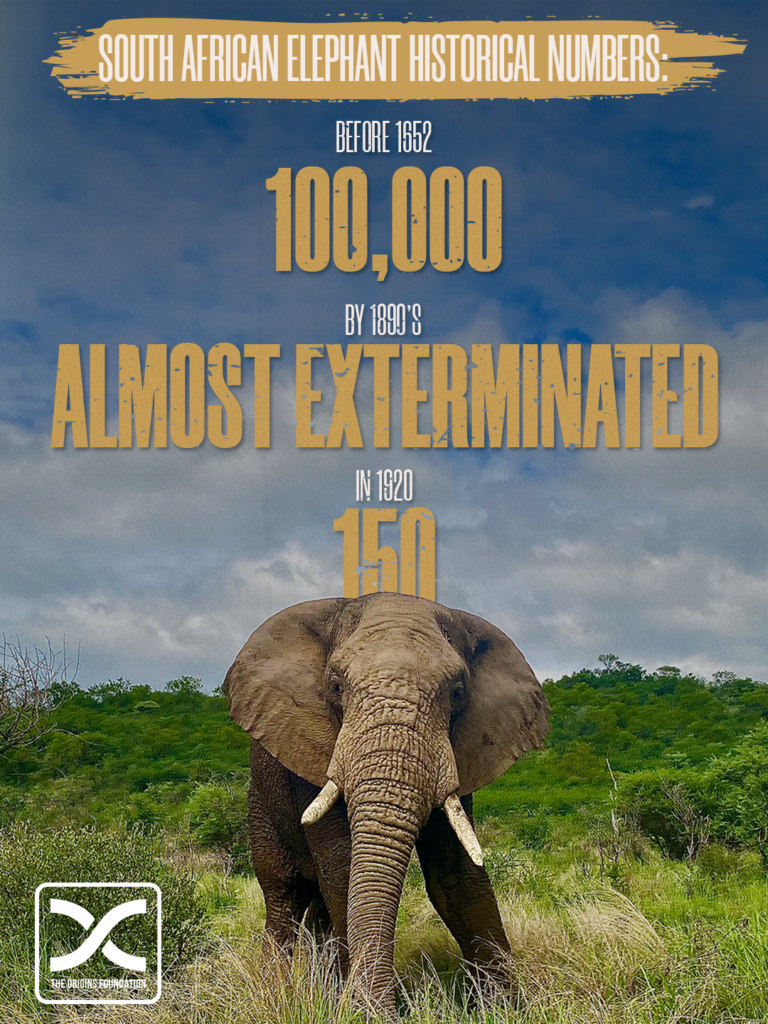
Historical numbers:

  • 100,000 before 1652 (Hall-Martin, 1992)
  • By 1890’s almost all of the elephants in South Africa have been exterminated (Whyte, 2001, Hall-Martin, 1992; Skead, 1980, 2007)
    • Pockets included Knysna, Addo, Tembe, Olifants Gorge
  • In 1920, there were approx. 130-150 elephants in the 4 populations (13 in Knysna, 16 Addo, 100 in the Lowveld, small population in Tembe).

CITES Quota: 150 (300 tusks)

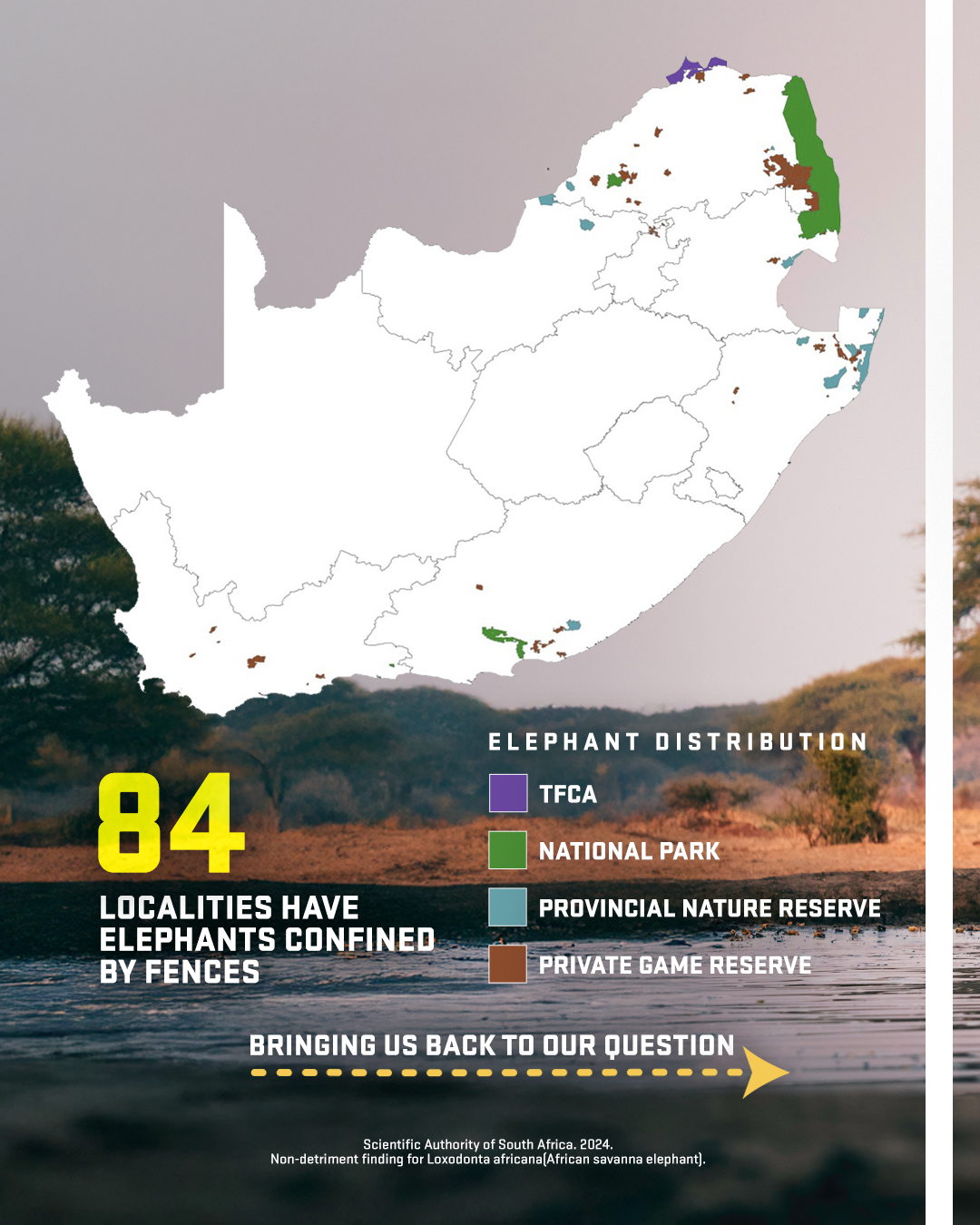
Only 84 properties in South Africa that hold elephants.

  • 63% (53) of all properties have less than 30 elephants

Large Elephant Populations in South Africa:

  • Madikwe – 1629 elephants
  • Greater Mapungubwe Transfrontier Conservation Area (GMTFCA) – 1970 elephants
  • Kruger, APNR, Sabie Sands, Makuya, Mayaleti, Greater Letaba Ranch
  • Addo Elephant Park Eastern Cape – 804
  • Hluhluwe-imfolozi – 864

High level, take home messages about elephants in South Africa:

  • CITES Appendix II listing
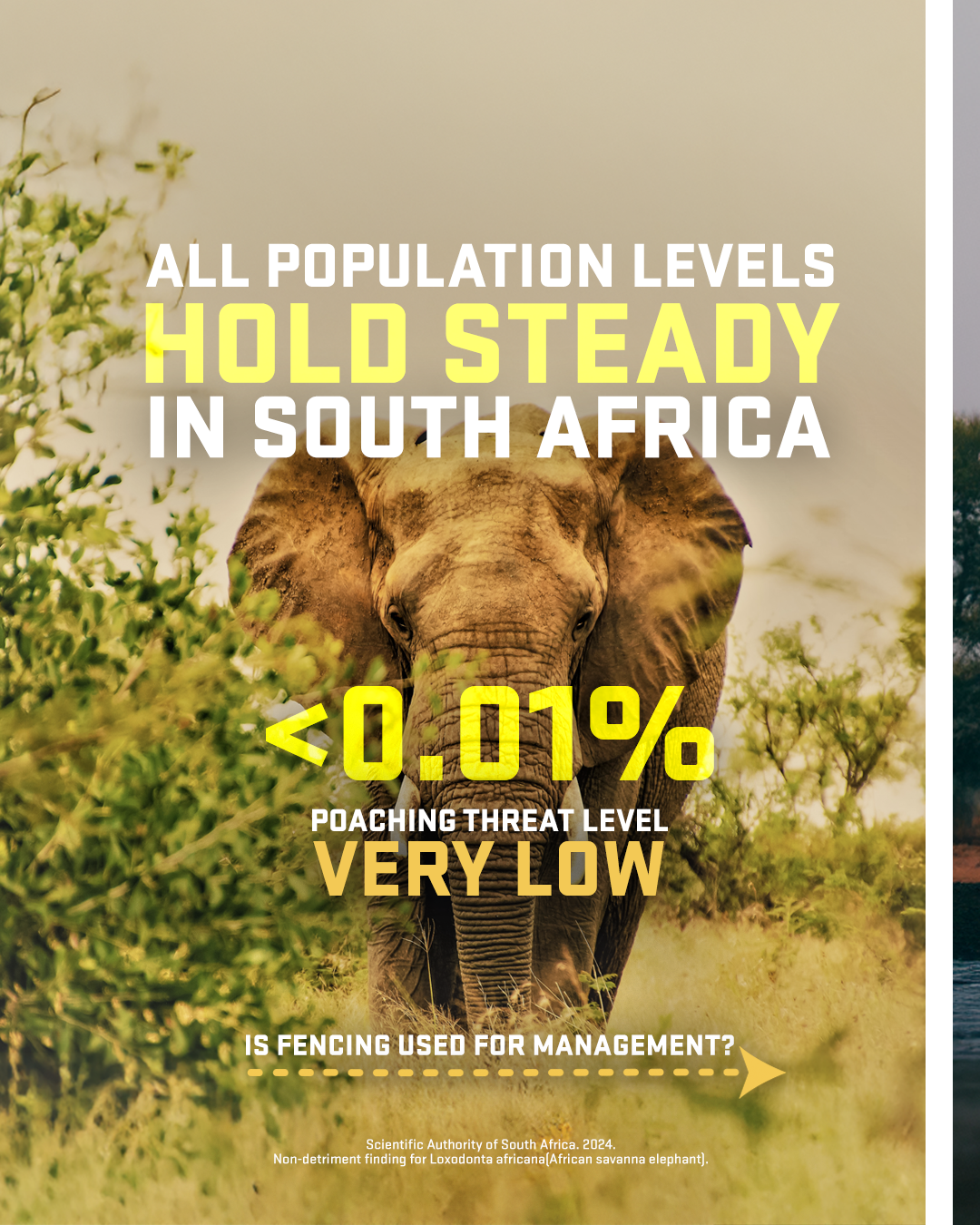
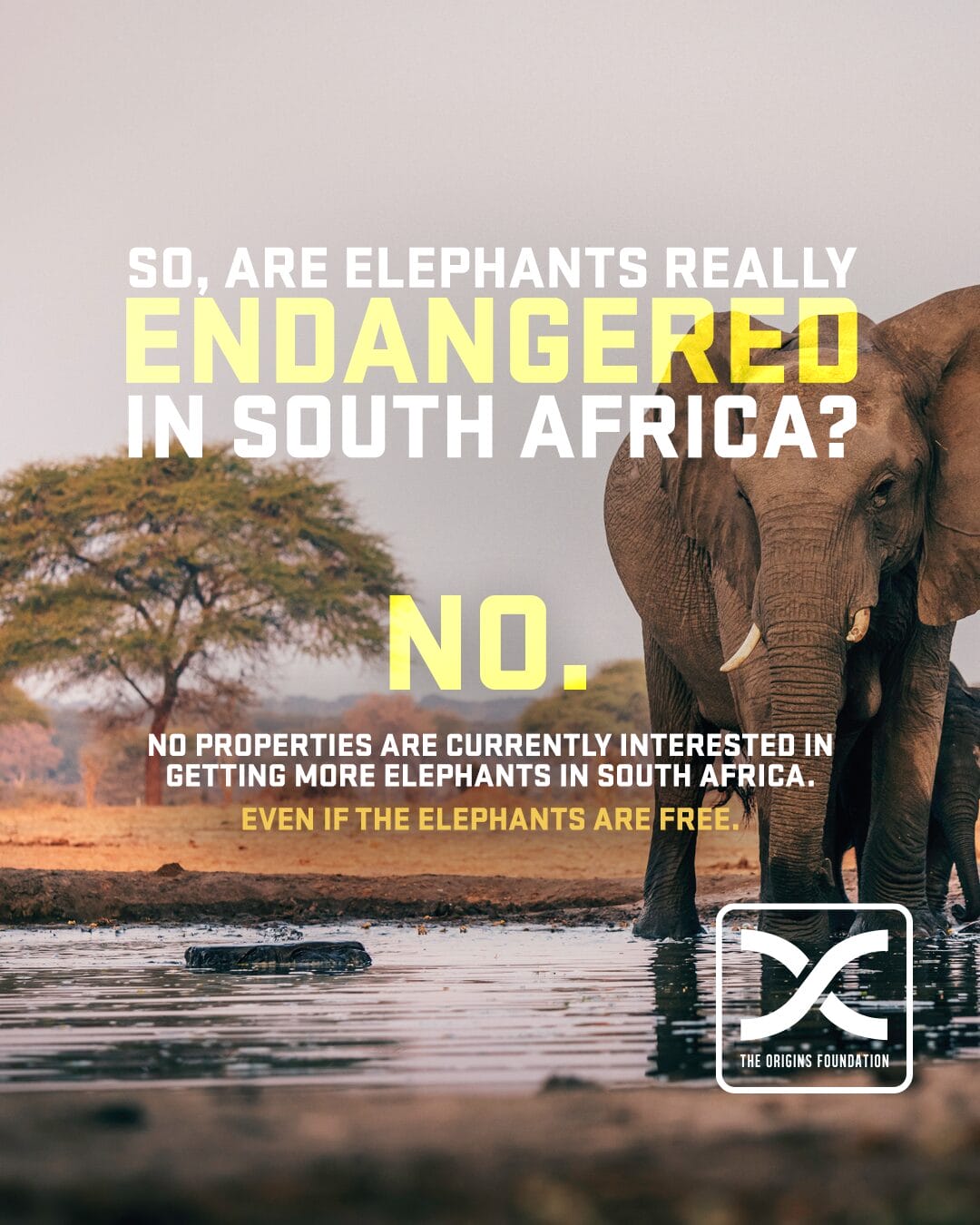
  • <0.01% loss of elephants through poaching; poaching is not a threat to elephants in South Africa
  • No new elephant properties coming online
  • No new space for elephants
  • Conservation Status: Least Concern
    • Highest elephant population in South Africa in a century
    • Smaller elephant populations actively contracepted
    • Increasing population

Specific Hotspots for Elephants in South Africa:

Madikwe:

Action, not finger-pointing, is needed for Madikwe’s elephants

At a crossroads: Sustainable solutions for Madikwe’s elephant overpopulation crisis

Kwazulu Natal:

Urgent call to relocate elephants as KZN reserves reach capacity

Kruger National Park:

  • 70% of elephants in South Africa are in Kruger
  • No hunting of elephants in Kruger
  • Trophy hunting under the strictest hunting protocols in Africa occurs on adjacent properties and is not a threat to elephant population numbers in Kruger

Kruger has the best dataset with respect to understanding age vs. ivory weight and length. Study performed by Dr. Ian Whyte and Anthony Hall-martin:

Growth characteristics of tusks of elephants in Kruger National Park

Kruger National Park management plan for elephants:

2012-2022 Management Plan

2023-2028 Management Plan

Podcasts around Elephants in South Africa:

Elephant Statistics:

SANBI NDF 2024

Carruthers et al., 2008

This is a chapter in a bigger book: Scholls, R.J., Mennell,, K.G. 2001. Elephant Management: A scientific assessment for South Africa. Wits University Press, Johannesburg, South Africa.

Jonathan Swift (1667-1745), through a poem, already indicated the future as it relates to elephants in that, where you have large settled concentrations of humans, one will find either no elephants or very few.

Sub-species of Elephant in South Africa:

Loxodonta africana

Ivory Trade “Touches / Implications”

  • Mapungubwe
    • AD900
  • Zimbabwe
    • AD1300
    • Shift from Map – to Zim
    • Maybe due to elephant densities / numbers
  • Axelson – 9,656kg of ivory for the Sofala Trade in 1517
  • Trader lineage of ivory in South Africa
    • Mapungubwe AD900-1300
    • Northern Nguni – southern Mozambique / Northern Kwazulu Natal (1500s)
    • Early 1600’s ivory leaving bay of Port Natal (Durban)
    • 1752 trekboers, Xhosa interaction – substantial ivory trade linked to Delagoa Bay
    • 1822 ivory was being traded between Tswana in the west and the Tsonga in the east.
  • Elephant exploitation started north and stretched south before the gold boom
  • Eighteenth century traders out of Cape of Good Hope in search of ivory
  • 1824
    • Ivory exports from Cape Town 9072kg
  • 1836
    • Ivory exports from Cape Town 48,000kg (Ellis, 1998)
    • B.Norden traded 2500kg with Dingane
  • 1855
    • 90,000kg of ivory exported from the Transvaal

What the Graph Suggests

The history appears to fall into three distinct phases:

  1. 1832–1869: Moderate but highly variable ivory exports, generally between 10,000 and 60,000 lbs/year.
  2. 1870–1883: A dramatic boom period, peaking around 165,000 lbs in 1878, likely reflecting intensified elephant hunting and expansion into elephant-rich regions north of the colony.
  3. 1884 onward: Abrupt collapse to roughly 5,000–15,000 lbs/year, suggesting severe depletion of accessible elephant populations and/or shifts in trade routes and hunting frontiers.

A reasonable central estimate would be approximately 30,000–40,000 elephants represented by the ivory exported through the Cape Colony between 1832 and 1909.

PeriodEstimated Total (lbs)
1832–1869~695,000
1870–1883~1,425,000
1884–1909~210,000
Total~2,330,000 lbs

*Podcasts*

*Reference List*

{Elephant Reference List}

< PREV
NEXT >

Origins

  • About Us
  • Wild Origins

Support

  • Corporate
  • Individual

Donate Now

Donate Now

SUBSCRIBE TO OUR EMAIL LIST AND KEEP UP
WITH EVERYTHING THE ORIGINS FOUNDATION.

This field is for validation purposes and should be left unchanged.

Explore

  • Documentaries
  • News
  • Podcasts
  • Truth
  • Proof
  • Stories
  • Projects
  • Events

Copyright ©  2026 | Cookie Policy | Privacy Policy

SUBSCRIBE TO OUR EMAIL LIST AND KEEP UP
WITH EVERYTHING BLOOD ORIGINS.

This field is for validation purposes and should be left unchanged.

Origins

  • About Us
  • Wild Origins

Support

  • Corporate
  • Individual

Donate Now

Donate Now

Explore

  • Documentaries
  • News
  • Podcasts
  • Truth
  • Proof
  • Stories
  • Projects
  • Events

Copyright ©  2026

Cookie Policy | Privacy Policy

Subscribe to our email list and keep up with everything The Origins Foundation.

This field is for validation purposes and should be left unchanged.