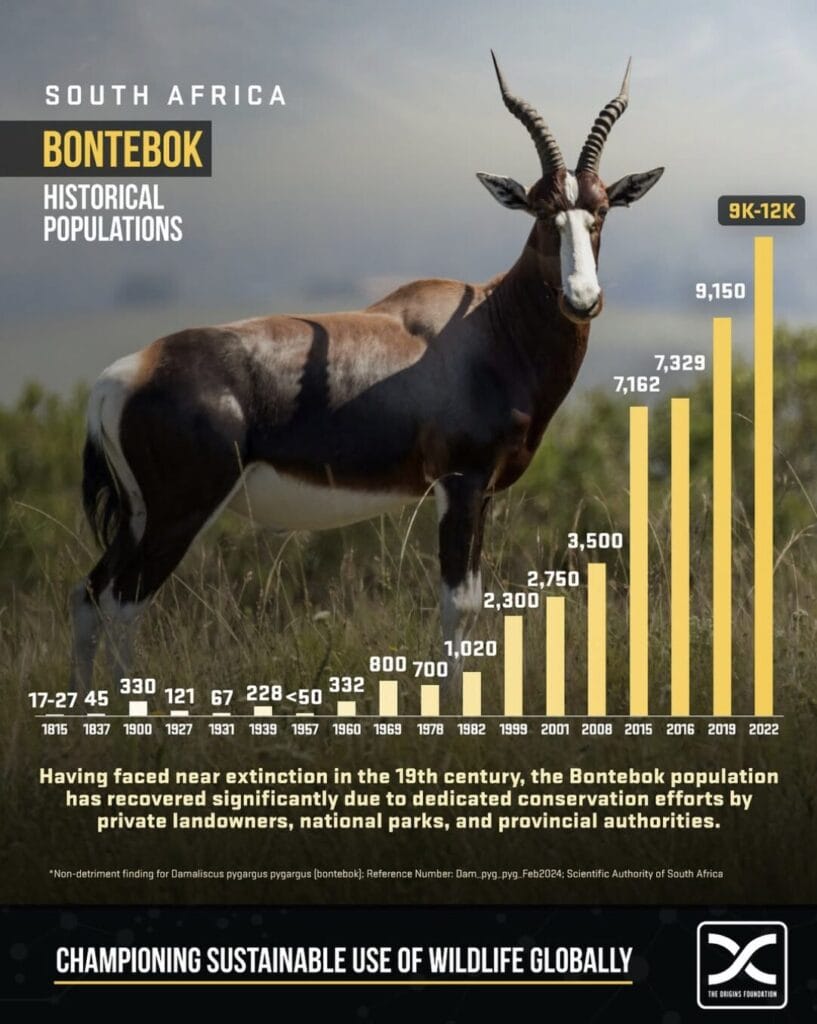
Among the many beautiful antelope species in Africa, the bontebok stands out as a symbol for species recovery in South Africa because of its miraculous conservation success story. A long history of collaborative conservation efforts brought the species back from the brink of extinction, bringing their numbers from a mere 17 in the early 1800’s to a thriving metapopulation of over 9,000 today. The bontebok’s recovery would not have been possible without the collaboration and commitment of private farmers, game ranchers, and government conservation initiatives, all of which have allowed us to appreciate the existence and resilience of the iconic species today.
The History
Bontebok’s decline started with the arrival of European colonists in the 17th century, when wild areas were cleared, essentially tamed, and converted for
agricultural use including livestock grazing. Naturally, competition from native wildlife with livestock, aka bontebok, created competition for grazing land. , and Bontebok populations were eventually depleted to as few as 17 individuals by the early 19th century, exist between just two private family farms that acknowledged their vulnerability (Furstenburg, 2023) . In 1836, due to their dwindling numbers, the South African government imposed a R75 fine for killing bontebok (Van Der Merwe, 1968) . By 1900, bontebok had been dispersed to multiple private farms in the region, and their numbers had grown to 330, but were then reduced to 121 by 1927 due to parasite infections (East, 1999; Furstenburg, 2016) .
In 1931, with bontebok numbers dwindling below 100, the first public protected land was set aside for bontebok near Bredasdorp called Bontebok Park.
The park contained 17 bontebok, while 50 remained on private lands (Furstenburg, 2016) . However, the renosterveld vegetation in the park was unpalatable to the bontebok, and the herd struggled from copper deficiency, parasite infections, and poor grazing quality (Barnard & Van Der Walt, 1961; Furstenburg, 2016; IUCN, 2015) . This prompted the surprising decision to move the park about an hour away, where a new Bontebok Park was established in a better environment near Swellendam (Barnard & Van Der Walt, 1961) . This is where Bontebok Park remains today, with its bontebok population fluctuating at around 250 since the 1980’s (Furstenburg, 2023) .
The true proliferation and success of bontebok populations can be attributed not only to protected areas such as Bontebok Park, but is largely thanks to the commitment of private farmers and game ranchers. Beyond the few families who protected the last remaining bontebok in the 1830’s, private landowners have been a lifeline of support for bontebok in the decades since their endangerment. By the 1960’s, several provinces were involved in the translocation of bontebok between nature reserves and private ranches across the country, creating a network of stable, growing bontebok herds (Furstenburg, 2016; Miller, 2015) . As this network of bontebok increased, enough bontebok were available to support sustainable hunting of the species.
A Market that allows Wildlife to Thrive
Once a market emerged for hunting in South Africa, there was a significant country-wide shift from cattle ranching to game ranching, which created a financial incentive for conservation of many species and their ecosystems, including the bontebok (Miller, 2015) . Private hunting has been highly successful in improving bontebok populations both in number and species health. By 1998, about half of South Africa’s bontebok lived on private lands (East, 1999) and by 2015, that proportion increased to 87% of the country’s bontebok (Furstenburg, 2016; Mulders, 2015) . The growth of game ranching and the popularity of recreational hunting created a financial incentive for landowners to grow bontebok populations, which has been instrumental in their recovery to between 9,819-11,0692 individuals worldwide today (Scientific Authority of South Africa, 2024) .
Regulatory Burden on Sustainability
As bontebok hunting grew in popularity, an important milestone came from the US Fish and Wildlife Service’s (USFWS) decision to allow bontebok trophy import permits in 1997 after an enhancement finding proving that hunting was beneficial to bontebok populations. This opened up African bontebok hunting to an entirely new market of American hunters, which further financially incentivized bontebok conservation on private land. However, in 2018, the USFWS found the 1997 enhancement finding outdated, meaning import permits are now approved on a case-by-case basis (USFWS n.d.) . This essentially requires individual enhancement findings for every permit application, which has slowed the process of bontebok hunting imports among Americans and will likely be detrimental to bontebok proliferation in South Africa as a result (Ronis, 2018) .
While the USFWS may intend to err on the side of caution to protect bontebok, their decision may do more harm than good for bontebok conservation, which is largely carried out by game ranchers. Just before the 2018 decision to halt imports, only 3.1% of global bontebok populations were exported as trophies annually, while their populations had been increasing at a rate of up to 25% annually (Furstenburg, 2016). Still, the bontebok have been listed as Endangered under the Endangered Species Act since 1976 (41 FR 24062, 1976; Endangered Species Act, 16 U.S.C. §§ 1538(a), 1973). Though imports were allowed starting in 1997, their endangered status has not been reevaluated by the US in the last 50 years despite their incredible recovery.
A new non-detriment finding was conducted in 2024 which found that live trade and export of bontebok trophies poses a low risk to their survival in South Africa. In fact, they found that conservation outcomes are limited by international restrictions on trophy imports, noting that this limits the economic value of bontebok and in turn limits incentives for private landowners to continue conserving bontebok and their habitat (Scientific Authority of South Africa, 2024). Hunting bans and slow processing of permit applications, particularly in the US, were cited as negatively impacting conservation efforts by limiting economic incentives for private landowners.
The 2024 non-detriment finding states that trophy hunting provides the largest contribution of revenue to ecosystem restoration, by providing an incentive for restoration of lands from agricultural to natural uses (Scientific Authority of South Africa, 2024). This is carried out by wildlife ranchers, who almost all practice sustainable land management, according to a recent survey in the Eastern Cape of South Africa. 75% of private bontebok owners use trophy hunting revenue for procurement and ecological management of bontebok habitat, and more than 30% of private landowners own bontebok for their potential to cover conservation costs through trophy hunting revenue (Scientific Authority of South Africa, 2024). Of these game owners, almost all rely on international hunters—or a mix of local and international hunters—for reliable income.
Later this year at CITES CoP20 (Convention on the International Trade of Endangered Species of Wild Flora and Fauna), a proposal will be heard to delist bontebok from their current listing on CITES Appendix II (CITES, 2025). If approved, bontebok will be listed on no CITES appendices. Species such as bontebok listed under Appendix II are generally not endangered but could become endangered if trade is not monitored, therefore are subject to regulations including export permits. The proposing parties argue that the bontebok’s recovery stands as a testament to the success of these such programs, but that such a regulatory burden on South Africa is no longer necessary given that they are no longer threatened by trade, as demonstrated by the 2024 non-detriment finding.
Though faced with regulatory issues, hunting has been instrumental in the miraculous recovery of bontebok populations, and the game ranching industry will continue to support their conservation in the future. There are few species that could dwindle to only 17 individuals and live to tell the tale, let alone multiply to over 9,000, reclaim their native habitat, and continue increasing centuries later. The existence and abundance of bontebok today is a testament to the collaborative efforts between the government and private game breeding industry. Thanks to their efforts, future generations will be able to continue to appreciate these animals for years to come.
References
41 FR 24062 (1976). https://www.fws.gov/sites/default/files/federal_register_document/FR-1976-06-14.pdf
Barnard, P., & Van Der Walt, K. (1961). Translocation of the bontebok (Damaliscus pygargus) from Bredasdorp to Swellendam. Koedoe, 4(1), 105–109.
Convention on International Trade in Endangered Species of Wild Fauna and Flora (CITES). (2025, December 24). CONSIDERATION OF PROPOSALS FOR AMENDMENT OF APPENDICES I AND II. CoP20 Prop. 1. Twentieth meeting of the Conference of the Parties, Samarkand (Uzbekistan). https://cites.org/sites/default/files/documents/COP/20/prop/E-CoP20-Prop-01.pdf?gtranslate=ru
East, R. (1999). African Antelope Database 1998. (p. x + 434pp.). IUCN/SSC Antelope Specialist Group.
Endangered Species Act, 16 U.S.C. §§ 1538(a) (1973).
Furstenburg, D. (2016). Bontebok (Damaliscus pygargus pygargus): Wildlife Biologist Scientific Report. https://doi.org/10.13140/RG.2.1.2752.2801
Furstenburg, D. (2023). Wildlife & Game southern Africa PART 7—Bontebok: New research flips the bucket. Veteran-SA. 21–28.
IUCN. (2015). Damaliscus pygargus ssp. pygargus: Radloff, F., Birss, C., Cowell, C., Peinke, D., Dalton, D. & Kotze, A.: The IUCN Red List of Threatened Species 2017: e.T6236A50185717 [Dataset]. https://doi.org/10.2305/IUCN.UK.2017-2.RLTS.T6236A50185717.en
Miller, M. L. (2015, July 8). Bontebok Can’t Jump: The Most Dramatic Conservation Success You’ve Never Heard About. Cool Green Science: Stories of The Nature Conservancy. https://blog.nature.org/2015/07/08/bontebok-cant-jump-the-most-dramatic-conservation-success-youve-never-heard-about/
Mulders, J. (2015, December 6). Bontebok: Back from the Brink. Wildlife Ranching SA Magazine.
Ronis, E. (2018, March 13). USFWS takes middle-ground on trophy imports. The Wildlife Society. https://wildlife.org/usfws-takes-middle-ground-on-trophy-imports/
Scientific Authority of South Africa. (2024). Non-detriment finding for Damaliscus pygargus pygargus (bontebok) (Dam_pyg_pyg_Feb2024).
United States Fish and Wildlife Service. (n.d.). Permit No. 3-200-22: Import of Sport-Hunted Bontebok Trophies. https://www.fws.gov/service/3-200-22-import-sport-hunted-bontebok-trophies
Van Der Merwe, N. (1968). Die Bontebok. Koedoe, 11(1), 161–168.