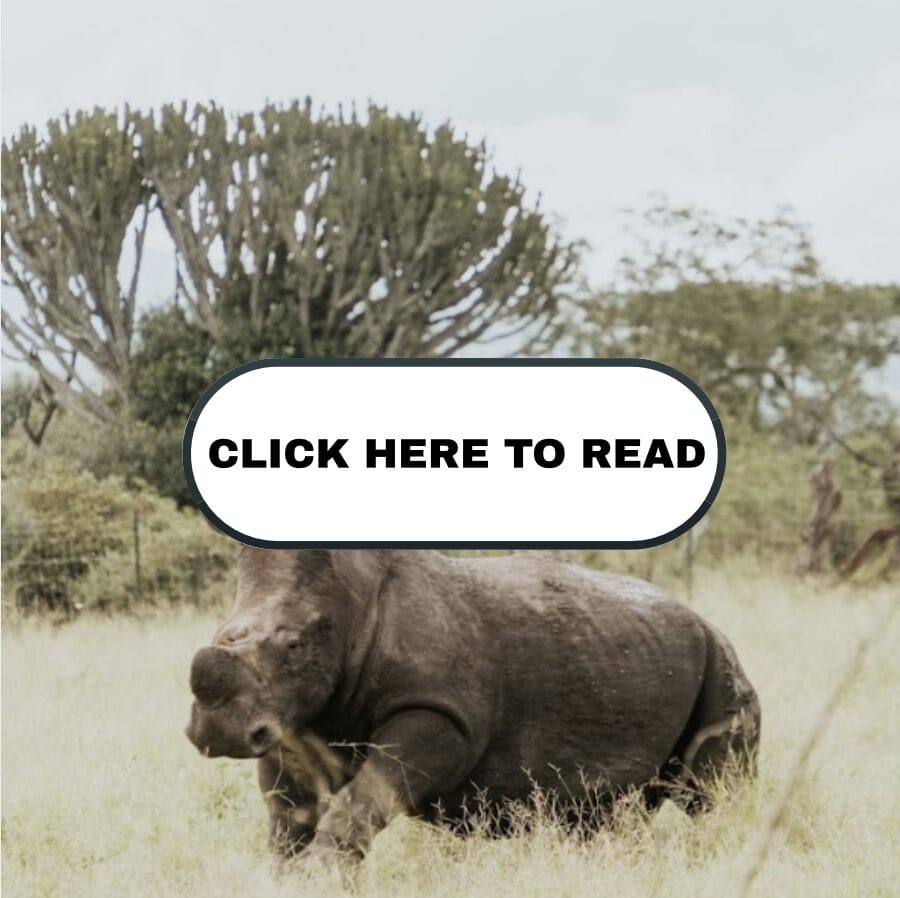
When thinking about the problems facing African rhinos, the first thing that will
likely come to mind is poaching. In the last decade, 8,000 rhinos were illegally killed by
poachers for their horn (Save the Rhino International, 2024) . This provides a major challenge
to rhino owners, who are faced with exorbitant anti-poaching costs every year to ensure the
safety of their rhino herds (Clements et al., 2020) . To justify the high cost of maintaining
healthy rhino herds, some rhino owners have utilized an alternative revenue source to be able
to support their anti-poaching efforts and prioritize the safety of their herds: hunting (Di
Minin et al., 2022; ’t Sas‐Rolfes et al., 2022) .
It may seem counterintuitive, but one solution to conserving Africa’s imperiled rhino
may lie in hunting them. Though both practices result in the loss of a rhino’s life, poaching
and hunting of rhinos are vastly different—opposite, in fact—when it comes to their impact
on rhino populations. While poaching has drastic consequences for rhino, hunting results in
far fewer losses and can actually benefit rhino conservation on the whole.
Poaching is the greatest threat to rhino populations today (Emslie, 2020) , accounting
for the loss of 2,437 African rhino between 2018 and 2021 (CITES, 2022) . This just includes
rhino in South Africa and Namibia, the only two countries with legal systems in place for
rhino hunting. In the same period, only 238 rhino were hunted in these countries (Ferreira et
al., 2022) . Poaching offtake is over tenfold that of hunting, which is highly unsustainable for
population success (Emslie, 2020) . Bringing it to present day, 90+ rhinos having been lost
from the Greater Kruger ecosystem in the first 60 days of 2025 through poaching. The reason
poaching is so devastating is that poachers kill rhino indiscriminately for their horn, no matter the size—this
results in the loss of breeding females and juveniles. This has a profoundly negative impact
on population growth, and can also leave rhino calves orphaned.
A great example of the impact of one breeding female on rhino population success is
Thandi. Thandi was left to die by poachers in 2012, but made a miraculous recovery due to
the lifesaving work of veterinarian Dr. William Fowlds and his team (Helping Rhinos, 2022) .
In 2015, Thandi gave birth to a calf, Thembi, meaning Hope. Thandi continued her legacy of
life with the birth of three more calves in 2017, 2019, and 2021. Her daughter Thembi has
also given birth to a calf of her own. Thandi’s legacy of life, hope and justice is a testament to
the invaluable importance that one female rhino can have on the success of a given
population of rhino.
As opposed to breeding females, certain male rhinos can have less ecological
significance in terms of population growth, and regular offtake through relocation or hunting
is actually recommended to maintain productive population densities (Adcock, 2019) . Excess
males can cause harm by wounding or killing females and juveniles (’t Sas‐Rolfes et al.,
2022) . Female-biased populations have been shown to grow faster than male-biased ones, and
relocating males is limited due to potential for fighting and lack of breeding potential in
male-only populations (’t Sas‐Rolfes et al., 2022) . For these reasons, offtake of male rhinos
is not only not detrimental to population growth, but it can actually be beneficial.
In addition to the ecological benefits of regulated rhino hunting, the practice also
serves as a crucial source of revenue for many rhino owners. With annual anti-poaching costs
reaching up to $150,000 or more, the cost of maintaining rhino herds is significant (Emslie et
al., 2018) . Revenue generated from hunts varies, but a single white rhino hunt can bring in
about $59,000, while a black rhino hunt can bring a staggering $314,000 (’t Sas‐Rolfes et
al., 2022) . This revenue can directly support maintenance of healthy rhino herds and allow
proper investment into anti-poaching measures to ensure their protection, as well as provide a
financial incentive to grow rhino herds.
Ruan Marx, the owner and operator of a private hunting and game breeding operation
in South Africa, believes that “as long as the legal hunting for the white rhino in South Africa
is open and the US and other countries keep allowing imports of rhino trophies, the species
will definitely continue on. Without hunters’ dollars, our industry and our animals are worth
nothing—the hunters’ dollars are what actually pays for the continuation of the species.”
Marx explains that the costs involved in raising and protecting rhino are exorbitantly
high, and breeding them for conservation alone wouldn’t make sense as an investment. “If
you take the monetary value away tomorrow, I think the rhino will die,” he acknowledges.
This statement was confirmed by Cullen Kelly, another private operator, “Having rhino’s on
our private areas is a huge liability risk, as well as an expensive endeavor, but one we are
happy to undertake.” “We do it because it’s the right thing to do, but it we weren’t able to
hunt out rhinos that cost to protect them would have to be covered elsewhere, and those funds
are very difficult to get”. Their monetary value is what’s keeping the rhino alive, through
private owners who can use hunting revenue as one source of income to justify keeping up
with rhino breeding programs.
With rhinos still under constant threat from poachers, it’s important to keep rhino
conservation efforts focused on reducing poaching losses. Hunting has proven to be a
successful tool for rhino conservation in South Africa and Namibia without any demonstrable
negative impacts to population success or conservation efforts (Emslie et al., 2018) . The
practice should continue to be utilized to ensure a sustainable future for rhinos. As described
by Marx, “At the end of the day, the hunter is the one putting the monetary value on an
animal. Whenever there’s a monetary value, the animal will be taken care of.”
Sources:
Adcock, K. (2019). Status and management of black rhino in Namibia, South Africa
Zimbabwe, Botswana, Zambia, Malawiand eSwatini to December 2018. SADC Rhino
Management Group.
Clements, H. S., Knight, M., Jones, P., & Balfour, D. (2020). Private rhino conservation:
Diverse strategies adopted in response to the poaching crisis. Conservation Letters,
13(6). https://doi.org/10.1111/conl.12741
Convention on International Trade in Endangered Species of Wild Fauna and Flora (CITES).
(2022). CoP19 Doc. 75. Species specific matters: RHINOCEROSES
(RHINOCEROTIDAE SPP.). https://cites.org/sites/default/files/documents/E-CoP19-
75.pdf
Di Minin, E., ’t Sas-Rolfes, M., Selier, J., Louis, M., & Bradshaw, C. J. A. (2022).
Dismantling the poachernomics of the illegal wildlife trade. Biological Conservation,
265, 109418. https://doi.org/10.1016/j.biocon.2021.109418
Emslie, R. (2020). Ceratotherium simum ssp. simum: The IUCN Red List of Threatened
Species. e.T39317A45814320 [Dataset]. https://doi.org/10.2305/IUCN.UK.2020-
1.RLTS.T39317A45814320.en
Emslie, R., Milliken, T., Talukdar, B., Burgess, G., Adcock, K., & Knight, M. H. (2018).
African and Asian Rhinoceroses – Status, Conservation and Trade- A report from the
IUCN Species Survival Commission (IUCN SSC) African and Asian Rhino Specialist
Groups and TRAFFIC to the CITES Secretariat pursuant to Resolution Conf. 9.14
(Rev. CoP17).
Ferreira, S. M., Ellis, S., Burgess, G., Baruch-Mordo, S., Talukdar, B., & Knight, M. H.
(2022). African and Asian Rhinoceroses – Status, Conservation and Trade (CoP19
Doc. 75 Annex 4). Secretariat of the Convention on International Trade in
Endangered Species of Wild Fauna and Flora (CITES).
https://cites.org/sites/default/files/EST/Annex%204%20-
%20CoP19%20Doc.%2075%20-
%20Res.%20Conf.%209.14%20(Rev.%20CoP17)%20par.%207%20report%20-
%20Final%20version.pdf
Helping Rhinos. (2022). Miracle Poaching Survivor Thandi Ten Years On: Her Story and
Legacy. www.helpingrhinos.org/miracle-poaching-survivor-thandi-ten-years-on-her-
story-and-her-
legacy/#:~:text=Thandi%20is%20a%20female%20white,world%20of%20her%20her
oic%20status
Save the Rhino International. (2024). Poaching Statistics. www.savetherhino.org/rhino-
info/poaching-stats/
’t Sas‐Rolfes, M., Emslie, R., Adcock, K., & Knight, M. (2022). Legal hunting for
conservation of highly threatened species: The case of African rhinos. Conservation
Letters, 15(3). https://doi.org/10.1111/conl.12877